Showing posts with label day of digital archives. Show all posts

Friday, October 12, 2012

Cloud storage and digital archives


Hello everyone! Since I am new here, I better introduce myself, but briefly. My name is Sarah Kim. I am a PhD student at the School of Information, the University of Texas at Austin. For several years, I have been exploring people’s everyday digital record-keeping practices. Personal digital archiving as a form of long-term digital record-keeping and value-determination practice is the phenomenon that I particularly focus on in my research. I have been asking people how they live with their digital documents. Today, I would like to share one of the questions that I have been thinking of based on my (personal) digital archiving research: Cloud storage and digital archives.

During the interview, I asked participants what they would pick first to rescue if there were a fire at their home, besides living things. Many participants mentioned an external hard drive or a personal computer. Although their answers may be influenced by other record-keeping related interview questions, if someone asks me the same question, I would think of taking my external hard drive that functions as my own digital archives (not as mere back-up storage). Digital documents (including pictures) stored on that device are vital for me to rebuild and continue my life. 

Recently, many IT companies are offering cloud computing services as massive data storage. IT researchers and practitioners often call cloud computing a new paradigm for computing. In fact, many people are already using cloud services to conduct their work and/or non-work related activities (e.g., Gmail, Google Docs, Dropbox and many others). Cloud storage has a potential as a future platform for personal digital archives (as well as digital storage of memory institutions  — Interesting survey results of National Digital Stewardship Alliance member preservation storage systems: http://blogs.loc.gov/digitalpreservation/2012/01/partly-cloudy-trends-in-distributed-and-remote-preservation-storage-more-results-from-the-ndsa-storage-survey/).

This makes me curious about how my participants’ answers will change once they actively start using cloud storage to keep and preserve their personal digital documents and furthermore how our digital archiving practices will change with the new technology?
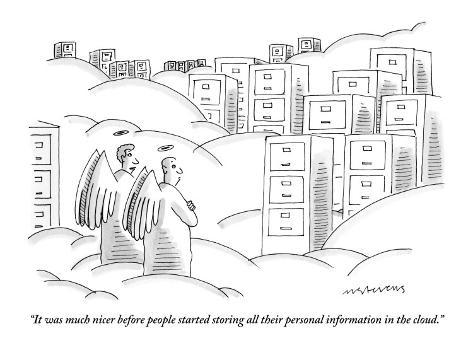
(Well-known New Yorker Cartoon by Mick Stevens, Published November 21, 2011)

It is highly likely that more people (and memory institutions) will be interested in using cloud storage as their digital archives considering benefits associated with it and the overall trend in IT industry. Cloud storage, (expected to be) maintained and monitored by IT experts, could be a relatively more secure place, considering the technical vulnerability of  more conventional digital storage media that many people are using such as external hard drive. Cloud storage services offer other useful functions such as sharing documents with others, synchronizing digital materials between different devices, tagging, and so forth. Also, cloud computing is still in early stages of development in general.

There are, however, many questions to ask to clear the cloud of cloud computing. For example, concerns for privacy (We are very familiar with horror stories about data hacking, personal information selling, identity theft and so forth) and feeling of losing control over their personal documents (Who owns what on the Web?), and building trust between users and services providers (How much can we trust the work ethics and long-term sustainability of these commercial services?) remain vital issues that we need to think of. 

From an archival perspective, I think, memory institutions’ (especially archives) working experiences with cloud storage service providers can offer a great insight into how we can inject archival thinking (e.g., what archives means, values of documents, and so forth) and practices in the design and development of these services. 

Thank you for reading.
Sarah Kim 
(Personal digital archives research blog: http://personaldigitalarchives.blogspot.com/)

New perspectives can translate to new opportunities

I’m the Digital Collections Archivist at Kennesaw State University in Kennesaw, Georgia. Kennesaw State is the third largest public university in the University System of Georgia, with a current enrollment of 23,103 for the Spring 2012 semester. Founded in 2004, the Archives consists of one full-time Archivist (me), a part-time Archivist, who also works half-time in the Bentley Rare Book Gallery, and an Associate Director. From 2004 to 2008, when I was hired, the Archives was staffed solely by the Associate Director. For the 2011 Day of Digital Archives, I created a photo essay to illustrate the different roles and responsibilities in my position. It was appropriate for the time, because our department was growing and expanding. We merged with the art and history museums on campus to form a super-department: Museums, Archives & Rare Books. This year, though, feels like one of retrenchment. We lost a long-time member of staff at the beginning of the year. The redistribution of her workload among the remaining staff brought fresh eyes and energy to some long-standing issues. We were able to use it as an opportunity to make significant progress on projects that had been stalled. In light of the difficult economy and constant budget cuts, I think similar organizations will find our actions of interest.

Writing it down 

At the beginning of the year, we hired a Records Manager, the first in the history of the university. She’s been working to understand and document the workflow of records creation and disposition across departments in the university. We don’t have an enterprise document management solution, so it’s been quite an undertaking. As part of her duties, the Records Manager has also inventoried records at our off-site storage vendor, identifying and transferring materials with historical significance to the Archives. Although the mission of the Archives is to collect and maintain university records that document its activities and history, we found that we had no recognized authority to transfer records without the consent of the department or division head. Trying to find someone who was willing to accept responsibility or to grant permission was an exercise in futility. After trying to track down one division head over the summer, it was decided that we needed to seek the authority to transfer records deemed to fall within our collecting policies. The problem was we had few written policies.

The department formed a policy committee with representatives from the museums, Rare Book Gallery, and the Archives to develop unified collection management policy. We found that we were able to use the same language and concepts, adding specific examples or language for situations unique to each unit. After several iterations, the committee was able to create a collections management policy over the summer. It’s currently awaiting final approval by the Chief Information Officer before being implemented. Once this is in place, we are ready to submit the transfer authorization proposal to the President’s Committee for approval. The completion of the collection management policy spurred interest and development in additional policies and procedures, including reproduction, access and use, and registration, as well as related forms. We’re currently working on creating copyright policies. My particular focus is developing guidelines to help users to understand copyright restrictions and to make responsible reproduction decisions.

Clearing it out

Looking at ongoing problems with storage space, both physical and digital, we created an ad hoc committee to review materials and make decisions regarding disposition. One of the first problems that we identified was a large amount of supplies and resources that had been amassed “just in case.” These included outdated or broken equipment, unnecessary or unusable supplies, and donations that did not meet our collecting areas or interests. The process of clearing out the space allowed us to reorganize supplies, to order new equipment, and to relish the sense of accomplishment. We used this momentum to tackle the shared drives and digital repository, both of which had become dumping grounds. The same committee developed policies to govern the shared drive, as well as file naming conventions. Using these new documents, we began a clean-up of the shared drive, which amounted to removing approximately 60 MB of duplicate or unnecessary files. The process turned out to be so easy that the committee offered the services to one of the museums. We were also able to incorporate elements into an outreach session on email best practices and plan to offer the service to other departments on campus.

Building it up 

The university is coming up on its 50th anniversary in 2013 and the Archives was approached to digitize historic images and to make them available for users. Currently, we rely on Archon to provide public access to our records and small files, such as oral history transcripts and low-resolution images. It was decided that it is inadequate to provide access to the high-resolution images required for the anniversary. I was tasked with comparing systems and making a recommendation. After much research, I determined that DSpace would best meet our requirements. We’re currently working with campus IT to implement a DSpace instance. As part of the DSpace project, I mapped the workflows of the Archives and identified current and future technology needs. This plan can now be used to ensure that we make strategic decisions based on demonstrated needs.

In addition to implementing new systems, we’re also focused on improving our current products and services. Archon was originally populated by importing data from our old CMS. It contains many records with minimum information. As part of the general commitment to bring consistency to our records, I’ve initiated a project to enhance the catalog on a record-by-record basis. This also allows me to check new accessions and add them to existing collections when appropriate, as well as to verify location and beef up the MARC record in the library’s OPAC. The project has already revealed some MARC mistakes and location errors.

By mapping the Archives’ core functions and relating them to technology needs, we are able to offer products and services of higher quality and with greater efficiency. We were also able to use our clean-up as a template for new services. While retrenchment may not seem as exciting as rapid expansion, it can still be an opportunity for growth and improvement. Please feel free to contact me if you'd like to ask any questions or follow up. You can reach me at agraha31 (at) kennesaw (dot) edu.

Many thanks to Gretchen for providing the opportunity and forum!

Friday, October 7, 2011

Analog-to-digital video preservation and a site visit to a repair facility at the NASA Ames Research Center

Hello everyone, happy day of digital archives! I'm Lauren Sorensen, Preservation Specialist working at Bay Area Video Coalition, a technology non-profit devoted to inspiring social change by enabling the sharing of diverse stories through art, education and technology. Our preservation department specifically works to preserve and provide support to archives with film, video, and moving image and audio material in their collections. We are one of the only non-profit vendors for high-quality preservation of video and audio in the country.

My blog entry can be found on our home site blog here, and involves a site visit from earlier this year, when I met in person for the first time Ken Zin, who works on the NASA Ames Research Center campus (at the site of a former MacDonald's there!) repairing obsolete reel-to-reel videotape machines. His work is essential to us because he is one of the only experts left in the country doing this specialized type of work. Because these decks feature heads (the part of the machine that reads the magnetic waveforms on the tape) that are proprietary to the companies that made them in the 1970s and 1980s, it is a real challenge keeping them in proper working order for high quality preservation. Realignment and regular maintenance is important in maintaining a facility that is appropriate for preservation services; we maintain these decks as we would museum artifacts because they are some of the last working machinery that is available to transfer 1/2" open-reel machines; after these decks are no longer operational, any magnetic recordings held in archival collections will be lost.

Please enjoy the photos!

Thursday, October 6, 2011

Day of Digital Archives

My Day of Digital Archives is not going at all as planned. I meant to be working on web archiving and training my students in processing the e-records of our last University President. Instead, I'm sitting at home typing one-handed and nursing a broken elbow (on my dominant arm, of course) sustained in a cycling crash yesterday on my way to work. So this post will be pretty short, and if anything catches your interest feel free to email me at khomo [at] uoregon [dot] edu for more information.

First, a little background about me: I'm the Electronic Records Archivist at the University of Oregon. I'm responsible for the ingest and preservation of e-records in Special Collections and University Archives. My current most pressing projects:
  • Processing raw video files of oral histories documenting the Latino experience in Oregon. I had a plan, and then Final Cut X threw a wrench in the works: the raw video footage created in Final Cut 7 can't be read with Final Cut X. This is a textbook example of why proprietary digital formats are not a preservation solution.
  • The aforementioned presidential e-records. Organic file trees are a nightmare, and trying to sort out the records designated as non-permanent by state law only adds to the confusion.
  • Creating an inventory of all our audio-visual material in order to prioritize both for digitization and for traditional preservation/conservation.
  • Doing some pre-emptive work with a couple of faculty members who are teaching oral history classes this academic year and who want their students to deposit the audio files in the archives. I'm happy to take the content, but if I work with the professors ahead of time and get myself scheduled to do some basic instruction in the class I'm far more likely to get usable files at the end of it.
  • Archiving University web content, both from the official UO pages and from other sources (social media, news outlets, etc.)
  • Working with our data management team to create ingest and cataloguing workflows for acquired digital data.
I think that's it. Now excuse me while I take some pain medication.

McLuhan's Understanding Media: "The [digital] medium is [no longer] the [only] message."

Happy Day of Digital Archives
David Kay, nydawg [New York Digital Archivists Working Group]
October 6, 2011

McLuhan: “The Medium Is the Message?” or “The [digital] medium is [no longer] the [only] message.”

This year marks the 100th anniversary of the birth of “the new spokesman of the electronic age”, Marshall (Understanding Media) McLuhan, and digital archivists should take a moment to think about how media, digital and analog, hot and cool, and in many different formats change our jobs, lives and responsibilities. With threats of technological obsolescence, vendor lock-in, hardware failure, bit rot and link rot, non-backwards compatible software, and format and media obsolescence, digital archivists need a system to accurately describe digital objects and assets in their form and function, content, subject, object and context. If we miss key details, we run the risk of restricting access in the future because, for example, data may not be migrated or media refreshed as needed. By studying and understanding media, digital archivists can propose a realistic and trustworthy digital strategy and implement better and best practices to guarantee more efficiency from capture (and digitization or ingest) and appraisal (selection and description), to preservation (storage) and access (distribution).

Over the last ten, forty, one hundred and twenty thousand years, we have crossed many thresholds and lived through many profound media changes-- from oral culture to hieroglyphic communications to the alphabet and the written word, and from scrolls to books, and most recently transiting from the Atomic Age (age of atoms) to the Information Age (era of bits). While all changes were not paradigm shifts, many helped shift currencies of trust and convenience to establish new brand loyalties built on threats of imminent obsolescence and vendor lock-in. As digital archivists, we stand at the line separating data from digital assets, so we need to ensure that we are archiving and preserving the assets and describing the content, technical and contextual metadata as needed.

Want to read the rest? Check out the New York Digital Archivists Working Group [#nydawg] wordpress blog. Thanks for your interest in #DigitalArchivesDay #DoDA.