Hello everyone! Since I
am new here, I better introduce myself, but briefly. My name is Sarah Kim. I
am a PhD student at the School of Information, the University of Texas at Austin. For several years, I
have been exploring people’s everyday digital record-keeping practices. Personal
digital archiving as a form of long-term digital record-keeping and value-determination practice is the phenomenon that I particularly focus on in my research. I have been asking
people how they live with their digital documents. Today, I would like to share
one of the questions that I have been thinking of based on my (personal) digital
archiving research: Cloud storage and digital archives.
During the interview, I
asked participants what they would
pick first to rescue if there were a fire at their home, besides living things. Many
participants mentioned an external hard drive or a personal computer. Although
their answers may be influenced by other record-keeping related interview questions, if someone asks me the same question, I would think of taking my external hard drive that functions as my own digital
archives (not as mere back-up storage). Digital documents (including pictures) stored
on that device are vital for me to rebuild and continue my life.
Recently, many IT companies
are offering cloud computing services as massive data storage. IT researchers and
practitioners often call cloud computing
a new
paradigm for computing. In
fact, many people are already using cloud services to
conduct their work and/or non-work related activities (e.g., Gmail, Google Docs, Dropbox and many
others). Cloud storage has a potential as a future
platform for personal digital archives (as well as digital storage of memory
institutions — Interesting survey results
of National
Digital Stewardship Alliance
member preservation storage systems: http://blogs.loc.gov/digitalpreservation/2012/01/partly-cloudy-trends-in-distributed-and-remote-preservation-storage-more-results-from-the-ndsa-storage-survey/).
This makes me curious about
how my participants’ answers will
change once they actively start using cloud storage to keep and preserve
their personal digital documents and furthermore how our digital archiving
practices will change with the new technology?
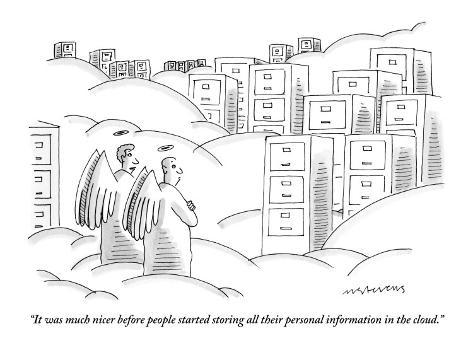
It is highly likely that
more people (and memory institutions) will be interested in using cloud storage
as their digital archives considering benefits associated with it and the overall
trend in IT industry. Cloud storage, (expected to be) maintained and monitored
by IT experts, could be a relatively more secure place, considering the technical vulnerability of more conventional digital storage media that
many people are using such as external hard drive. Cloud storage services offer
other useful functions such as sharing documents with others, synchronizing digital
materials between different devices, tagging, and so
forth. Also, cloud computing is still
in early stages of development in general.
There are, however, many questions
to ask to clear the cloud of cloud computing. For example, concerns for privacy
(We are very familiar with horror stories about data hacking, personal information selling, identity theft and so forth)
and feeling of losing
control over their personal documents (Who owns what on the Web?), and building
trust between users and services providers (How much can we trust the work ethics
and long-term sustainability of these commercial services?) remain vital issues that we need to think of.
Thank you for reading.
Sarah Kim
(Personal digital archives research blog: http://personaldigitalarchives.blogspot.com/)
